You have done everything right. You told your doctor about the exhaustion that sleep does not fix, the weight that will not move, the hair in the brush, and the strange sensitivity to cold. They ordered a thyroid test. The result came back, and you were told it was normal.
And yet nothing about how you feel is normal.
This is one of the most common experiences we hear about, and most of the time the problem is not that the testing was wrong. The problem is that it was incomplete. A standard thyroid screen usually measures a single number, TSH, and a single number cannot tell the whole story of an organ that touches nearly every system in your body. A complete thyroid panel measures more, and it often explains the gap between a normal result and a body that clearly disagrees.
What is a complete thyroid panel?
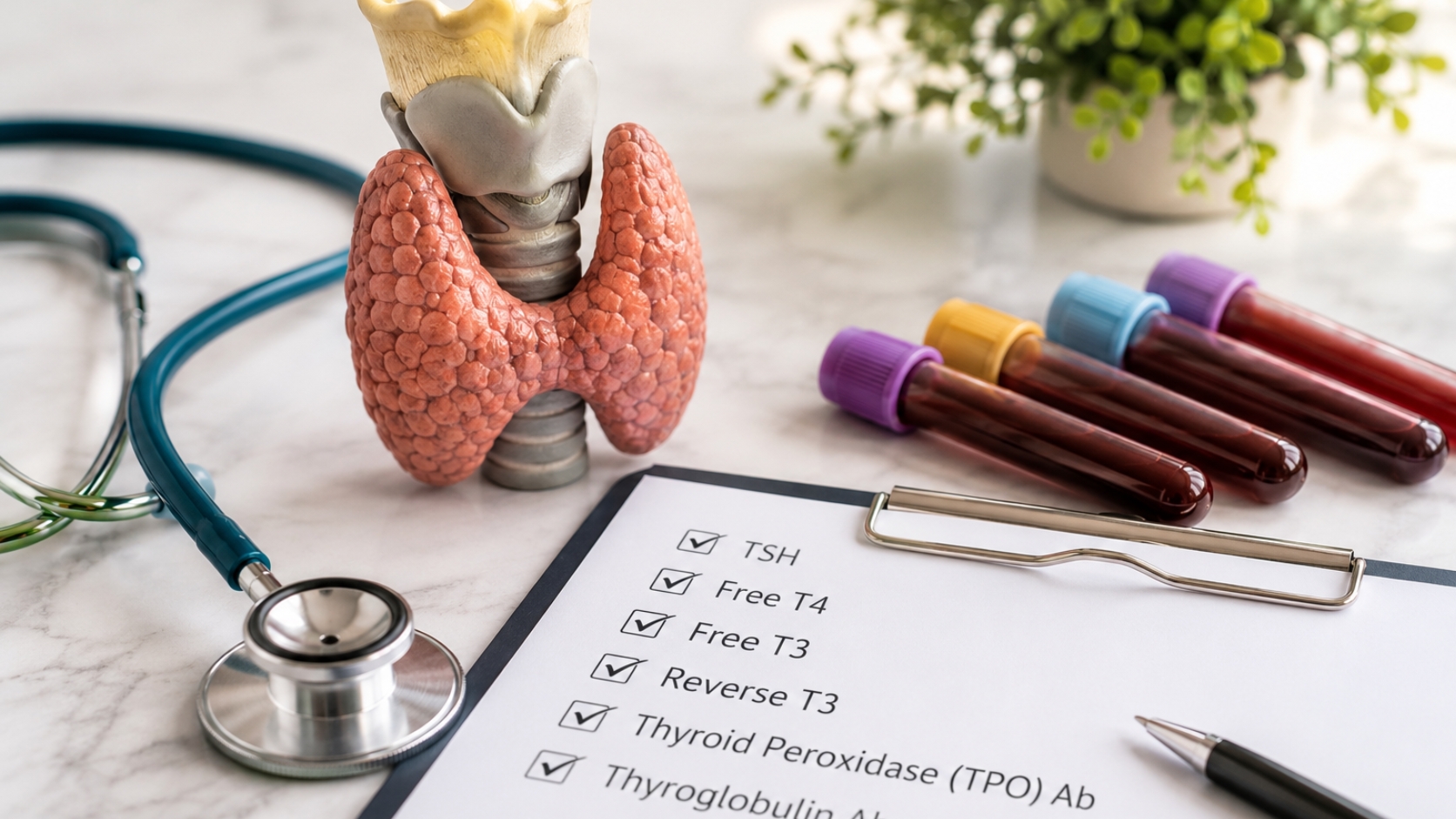
A complete thyroid panel measures the full chain of thyroid function rather than a single signal. At minimum it includes TSH, Free T4, Free T3, Reverse T3, and the two main thyroid antibodies, TPO and thyroglobulin. Each marker answers a different question, and together they show not just whether your thyroid is producing hormone, but whether your body can actually use it.
Here is what a comprehensive panel typically includes:
- TSH, the pituitary signal that tells the thyroid how hard to work
- Free T4, the main storage form of thyroid hormone in circulation
- Free T3, the active hormone your cells actually use
- Reverse T3, an inactive form that can block T3 from working
- TPO and thyroglobulin antibodies, which reveal autoimmune activity such as Hashimoto’s
Most standard panels stop at the first one. That is the heart of the issue.
Why isn’t TSH enough on its own?
TSH is a useful screening tool, but it is an indirect measure. It is produced by the pituitary gland, not the thyroid, and it reflects the brain’s instructions to the thyroid rather than the amount of usable hormone reaching your cells. You can think of it as the thermostat setting, not the temperature of the room.
TSH also moves around far more than most people realize. Levels are roughly 50 percent higher at night and in the early morning than during the rest of the day, and because secretion is pulsatile, repeated measurements in the same person can vary by as much as half of the reference range. A single draw at a single moment captures one frame of a moving picture.
Then there is the reference range itself. The upper limit of normal for TSH sits around 4 to 5 mIU/L in most labs, but that figure has been debated for years. When researchers used the presence of autoimmune thyroid disease as a calibration standard, the prevalence of Hashimoto’s began climbing once TSH passed roughly 2.6 to 2.9 mIU/L. In other words, a result of 4.0 may be labeled normal while sitting well above the point where early thyroid trouble starts to show up. Reference ranges describe a population. They were never designed to describe how you feel at your best.
What do Free T4 and Free T3 measure?
Free T4 is the storage form, and Free T3 is the active form. Your thyroid produces mostly T4, which is relatively inert until your body converts it into T3. T3 is the hormone that actually drives metabolism inside your cells, influencing energy, body temperature, mood, and weight. Measuring T4 without T3 tells you the warehouse is stocked without telling you whether the goods are reaching the shelves.
The conversion problem
Conversion is where a lot of people quietly run into trouble. The enzymes that turn T4 into T3 depend on adequate nutrients, healthy cortisol patterns, and an absence of significant inflammation. Chronic stress, dieting, illness, and nutrient gaps can all impair conversion. When that happens, you can have a perfectly normal TSH and Free T4 while your Free T3, the number that matters most for symptoms, sits at the bottom of the range or below it.
Conversion also depends on raw materials. The enzyme that activates thyroid hormone relies on selenium, and adequate zinc, iron, and a healthy gut all support the process. Deficiencies in any of them, which are common, can quietly throttle how much active hormone you actually produce, no matter what your TSH reads.
This is exactly the scenario a TSH-only screen misses. The signal looks fine. The active hormone does not.
What is Reverse T3 and when does it matter?
Reverse T3 is a mirror-image molecule the body makes from T4. It fits into the same receptors as active T3 but does nothing once it gets there, which means it can act as a brake on your metabolism. The body produces more of it during periods of significant stress, illness, injury, calorie restriction, and inflammation.
On its own, Reverse T3 is not a diagnosis. But when someone has clear symptoms, a normal TSH, and a low Free T3, an elevated Reverse T3 can help explain why the active hormone is not doing its job. It adds context that a basic panel simply does not provide.
What do thyroid antibodies reveal?
Thyroid antibodies tell you whether your immune system is involved. TPO and thyroglobulin antibodies are markers of autoimmune thyroiditis, most commonly Hashimoto’s disease, which is the underlying cause in roughly 60 to 80 percent of cases where TSH is mildly elevated. This matters enormously, because antibodies often rise years before TSH drifts out of range.
That early window is the whole point of testing them. Someone can have elevated antibodies, a normal TSH, and real symptoms, and a standard screen will call them healthy while an autoimmune process is already underway. Catching it early changes the conversation from managing disease to protecting function.
What symptoms should prompt a complete thyroid panel?
The thyroid influences nearly every system in the body, which is why its symptoms are so easy to blame on something else: stress, aging, a busy season of life. The pattern, more than any single complaint, is what should prompt a complete panel rather than a single TSH.
Common signs worth taking seriously include:
- Fatigue that a full night of sleep does not fix
- Unexplained weight gain or real difficulty losing weight
- Feeling cold when others are comfortable
- Hair thinning or loss, sometimes including the outer third of the eyebrows
- Dry skin, brittle nails, and constipation
- Brain fog, poor concentration, or low mood
- Irregular or heavy periods, or a noticeable drop in libido
If several of these overlap, particularly alongside a family history of thyroid or autoimmune disease, a single normal TSH is not enough to rule the thyroid out. That is precisely the situation a complete panel is built for.
A side-by-side look at the markers
| Marker | What it measures | Why it matters |
|---|---|---|
| TSH | The pituitary signal to the thyroid | Useful screen, but indirect and highly variable |
| Free T4 | Stored, inactive thyroid hormone | Shows production, not usability |
| Free T3 | The active hormone your cells use | Tracks most closely with how you feel |
| Reverse T3 | An inactive form that blocks T3 | Flags poor conversion under stress or illness |
| TPO / Tg antibodies | Autoimmune activity | Detects Hashimoto’s, often years early |
Normal versus optimal: what the reference range does not tell you
Here is the nuance that gets lost in a fast appointment. Common is not the same as optimal. Subclinical hypothyroidism, the early stage where TSH is elevated but thyroid hormones still read normal, affects somewhere between 4 and 10 percent of adults, and far more in older populations. Around a quarter of those people already have symptoms. Between a third and half of them will progress to overt hypothyroidism within ten to twenty years.
We want to be honest about the other side of this too. Not every borderline number requires treatment, and chasing perfect-looking labs without regard for how a person actually feels is its own mistake. The right approach is not to treat a single value in isolation. It is to read the entire panel against your symptoms, your history, and your goals, and to recheck over time rather than reacting to one snapshot.
There is also the matter of your personal set point. Each person has a relatively narrow individual range for thyroid hormones, considerably tighter than the broad population reference range printed on a lab report. A result that is normal for the population can still be abnormal for you. That is why your own history and how you feel carry real diagnostic weight, not just where a number falls inside a wide band.
How we approach thyroid testing at iRevive
At iRevive, we order the complete panel before drawing conclusions, and we read it the way the science suggests it should be read: as a system, not a single gauge. We look at whether your thyroid is producing hormone, whether your body is converting and using it, and whether your immune system is involved. Then we compare that picture to what you are actually experiencing.
Because we work through a concierge telehealth model, you are not rushed through a seven-minute visit and handed a one-word verdict. You work with the same provider over time, your results are explained in plain language, and your plan is adjusted as your numbers and your symptoms change. If your labs say normal and your body says otherwise, that gap is worth investigating rather than dismissing.
We also recheck rather than treat a single snapshot. Because TSH and thyroid hormones naturally fluctuate, a one-time result rarely tells the full story. Tracking your numbers over time, alongside how you feel, is how a pattern becomes clear and how a plan stays matched to your actual physiology rather than to one moment on one morning.
You deserve a complete answer. Sometimes a complete panel is the difference between being told nothing is wrong and finally understanding what is.
Frequently Asked Questions
What tests are in a complete thyroid panel?
A complete thyroid panel typically includes TSH, Free T4, Free T3, Reverse T3, and thyroid antibodies (TPO and thyroglobulin). This combination shows whether the thyroid is producing hormone, whether the body is converting and using it, and whether an autoimmune process is involved. A standard screen usually measures only TSH.
Can you have a thyroid problem with a normal TSH?
Yes. Because TSH is an indirect pituitary signal, it can read normal while active hormone (Free T3) is low or while thyroid antibodies are elevated. Many people with real symptoms and a normal TSH show abnormalities only when a complete panel is run.
Why does Free T3 matter more than TSH for symptoms?
Free T3 is the active hormone your cells actually use to drive metabolism, energy, and temperature. TSH only reflects the brain’s instruction to the thyroid. If conversion of T4 to T3 is impaired, Free T3 can be low even when TSH looks fine, which often explains ongoing symptoms.
What do thyroid antibodies tell me?
Elevated TPO or thyroglobulin antibodies indicate autoimmune thyroid activity, most often Hashimoto’s disease. Antibodies frequently rise years before TSH moves out of range, so testing them can identify a developing problem early, while function can still be protected.
Does iRevive test thyroid function by telehealth?
Yes. iRevive provides comprehensive thyroid testing and ongoing care through a concierge telehealth model across Florida. Lab work is ordered up front, results are reviewed against your symptoms, and your plan is adjusted over time with the same provider.
Medical Disclaimer: This article is for educational purposes only and is not medical advice. It is not a substitute for diagnosis or treatment from a qualified clinician. iRevive Integrative & Functional Medicine provides care via telehealth across Florida. Talk with a licensed provider about your individual health needs before making any changes.