If you have been researching medical weight management, you have probably seen the terms GLP-1, GLP-2, and GLP-3 floating around online. The numbers make it sound like a simple progression, and in a sense, they are. But the differences between these three classes of medication are more significant than most people realize, and understanding them matters if you are considering any form of peptide-based metabolic therapy.
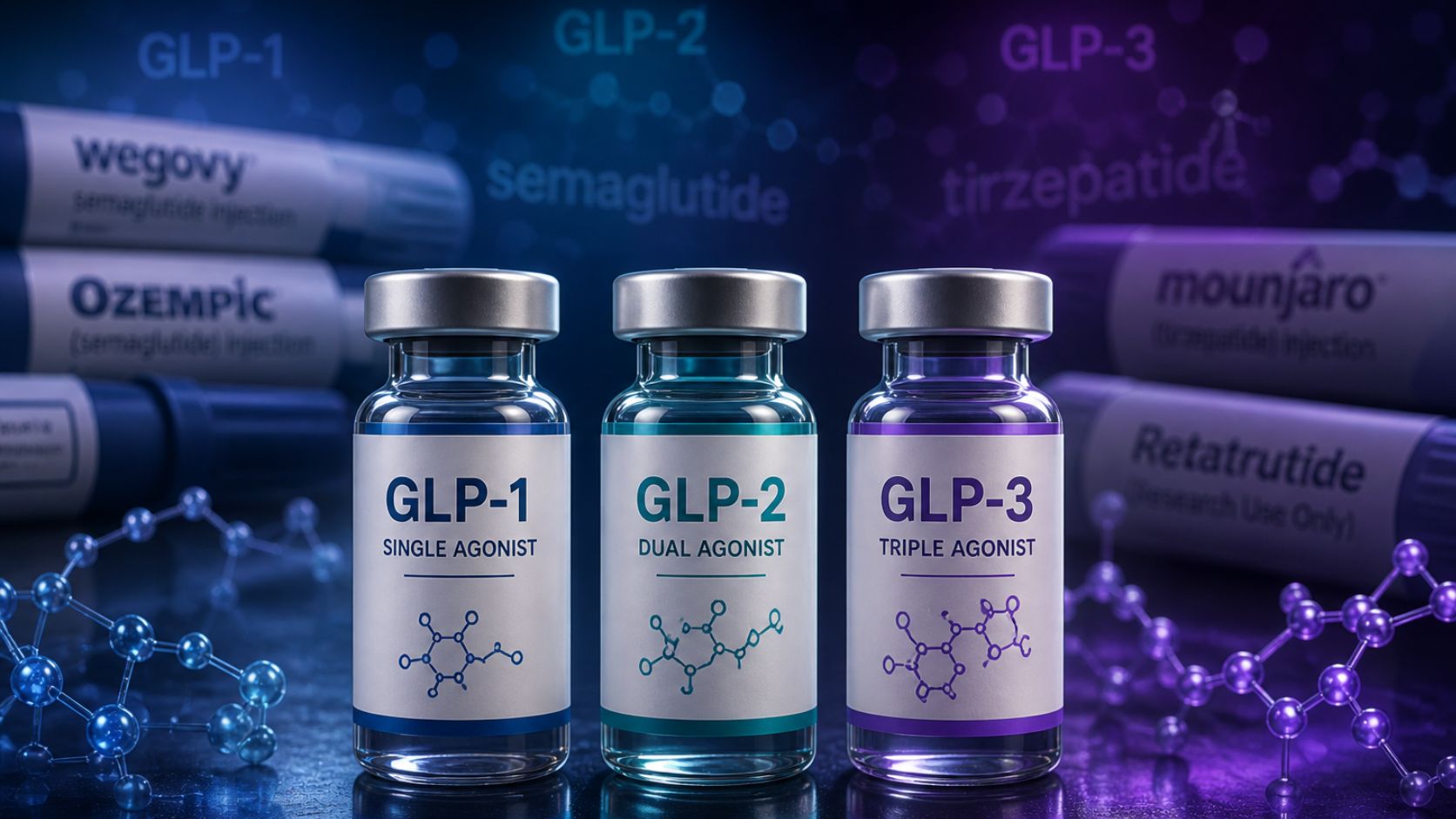
Here is the simplest way to think about it. GLP-1 medications activate one hormone receptor. GLP-2 medications activate two. And GLP-3 medications activate three. Each additional receptor changes how the medication works in your body, what kind of results you can expect, and what the tradeoffs look like. More receptors does not automatically mean better. It means different.
The science behind these medications is moving fast. A head-to-head trial published in the New England Journal of Medicine in 2025 showed that the dual agonist outperformed the single agonist by a significant margin. And Phase 3 data on the triple agonist is showing weight reduction numbers that exceed anything we have seen before. But clinical data is only part of the picture. The right medication for you depends on your metabolic profile, your health history, and how your body responds.
Let us break down what each class does, what the research actually shows, and how to think about which one fits your goals.
GLP-1 vs. GLP-2 vs. GLP-3: Side-by-Side Comparison
| Feature | GLP-1 (Single Agonist) | GLP-2 (Dual Agonist) | GLP-3 (Triple Agonist) |
| What It Means | Activates 1 receptor: GLP-1 | Activates 2 receptors: GLP-1 + GIP | Activates 3 receptors: GLP-1 + GIP + glucagon |
| Key Medication | Semaglutide (Wegovy, Ozempic) | Tirzepatide (Mounjaro, Zepbound) | Retatrutide (Eli Lilly, in Phase 3 trials) |
| FDA Status | FDA-approved for obesity and type 2 diabetes | FDA-approved for obesity and type 2 diabetes | Phase 3 clinical trials (not yet FDA-approved) |
| Mechanism | Mimics GLP-1 hormone: slows gastric emptying, reduces appetite, improves insulin signaling | Adds GIP signaling to GLP-1: enhanced insulin response, improved fat metabolism, greater satiety | Adds glucagon signaling to GLP-1 + GIP: increased energy expenditure and fat oxidation on top of appetite suppression |
| Weight Loss (Clinical Trials) | 13.7% body weight at 72 weeks (SURMOUNT-5) | 20.2% body weight at 72 weeks (SURMOUNT-5) | 24.2% at 48 weeks (Phase 2); 28.7% at 68 weeks (Phase 3 TRIUMPH-4) |
| Cardiovascular Data | 20% reduction in MACE (SELECT trial, NEJM) | 8% MACE reduction, 16% mortality reduction vs. dulaglutide | Reduced hsCRP, triglycerides, non-HDL cholesterol, blood pressure in trials |
| Common Side Effects | Nausea, vomiting, diarrhea, constipation (74-84% at higher doses) | Nausea, diarrhea, reduced appetite (generally comparable to GLP-1) | GI side effects (dose-dependent, mostly mild to moderate in trials) |
| Best Suited For | Patients seeking established, well-studied metabolic support with proven CV benefits | Patients who want more aggressive weight reduction with dual-receptor metabolic support | Select patients under close clinical supervision seeking maximum multi-receptor metabolic impact |
What Do GLP-1, GLP-2, and GLP-3 Actually Mean?
GLP stands for glucagon-like peptide, a family of hormones produced in your gut that play a central role in how your body regulates blood sugar, appetite, and metabolism. GLP-1 is the specific hormone that most of these medications are built around. It signals your pancreas to release insulin, slows gastric emptying so you feel full longer, and acts on appetite centers in your brain to reduce hunger.
The numbers 1, 2, and 3 refer to how many hormone receptors each class of medication activates. A GLP-1 drug activates one receptor. A GLP-2 drug activates two receptors (GLP-1 plus GIP, or glucose-dependent insulinotropic polypeptide). A GLP-3 drug activates three receptors (GLP-1 plus GIP plus the glucagon receptor).
A quick note on terminology. “GLP-2” and “GLP-3” are colloquial terms used by clinicians and patients to describe dual and triple receptor agonists. Scientifically, there is a separate hormone called glucagon-like peptide-2 that is involved in intestinal health, not weight management. But when your provider or a health article refers to “GLP-2 for weight loss,” they are talking about tirzepatide and dual-receptor activation, not the intestinal hormone. Context matters, and we will use the colloquial convention throughout this article because that is how most patients encounter these terms.
What Are GLP-1 Medications and How Do They Work?
GLP-1 medications are single-receptor agonists. They mimic the GLP-1 hormone your body produces naturally after eating, but they last much longer. The natural hormone breaks down within minutes. Medications like semaglutide (marketed as Wegovy for weight management and Ozempic for type 2 diabetes) are engineered to persist for days, providing continuous appetite suppression, improved insulin signaling, and slower gastric emptying.
Semaglutide is the most widely studied GLP-1 medication on the market, and the clinical data behind it is extensive. The STEP trial program established its efficacy for medical weight management. But the data that changed the broader conversation came from the SELECT trial, published in the New England Journal of Medicine, involving 17,604 patients with obesity and established cardiovascular disease. Semaglutide reduced major adverse cardiovascular events, including heart attack, stroke, and cardiovascular death, by 20% compared to placebo.
That is not just a weight loss statistic. That is a cardiovascular outcome, and it moved semaglutide from a metabolic medication to one with proven cardioprotective benefits. What makes the SELECT data particularly interesting is that the cardiovascular benefit was not fully explained by weight loss alone. Waist circumference reduction accounted for no more than 33% of the protective effect, suggesting anti-inflammatory or other metabolic mechanisms are at play. We are still learning exactly how that works.
GLP-1 Pros and Cons
Pros:
The most extensively studied class of incretin-based medication, with years of real-world data across thousands of patients. FDA-approved with well-established safety profiles. Proven cardiovascular benefits beyond weight reduction (SELECT trial: 20% MACE reduction). Widely available from licensed pharmacies with expanding insurance coverage. Strong clinical track record for patients with type 2 diabetes and obesity.
Cons:
Gastrointestinal side effects are common, particularly nausea, vomiting, and diarrhea, affecting 74-84% of participants at higher doses in clinical trials. Weight regain after discontinuation is well-documented. Muscle mass loss can accompany fat loss without proper resistance training and protein intake. Not appropriate for patients with a personal or family history of medullary thyroid carcinoma or MEN2. Produces less total weight reduction compared to dual and triple agonists in head-to-head trials.
What Are GLP-2 Medications and Why Do They Outperform GLP-1?
GLP-2 medications are dual-receptor agonists. They activate both the GLP-1 receptor and the GIP receptor simultaneously. GIP, or glucose-dependent insulinotropic polypeptide, is another gut hormone that enhances insulin response and plays a role in fat metabolism. The theory is that engaging both pathways produces greater metabolic effects than activating GLP-1 alone. And the clinical data confirms it.
The most prominent GLP-2 medication is tirzepatide, marketed as Mounjaro for type 2 diabetes and Zepbound for chronic weight management. Both are FDA-approved.
The strongest evidence comes from the SURMOUNT-5 trial, published in the New England Journal of Medicine in May 2025. This was a head-to-head comparison, the kind of trial the field had been waiting for. A total of 751 adults with obesity but without diabetes were randomized to receive either tirzepatide or semaglutide at their maximum tolerated doses for 72 weeks.
The results were decisive. Tirzepatide produced 20.2% body weight reduction compared to 13.7% with semaglutide. In absolute terms, that is roughly 50 pounds lost with tirzepatide versus 33 pounds with semaglutide over the same period. Tirzepatide also showed greater waist circumference reduction, 18.4 cm versus 13.0 cm. Both differences were statistically significant.
But here is the nuance that matters. More weight loss is not automatically better for every patient. Individual response varies. Some patients tolerate one agent better than the other. Your cardiovascular history, your metabolic markers, and your hormonal picture all factor into which medication is the right fit. At iRevive, we run comprehensive biomarker analysis before recommending any specific agent because the numbers on a clinical trial do not always translate one-to-one to what a given patient will experience.
GLP-2 Pros and Cons
Pros:
Statistically superior weight reduction compared to semaglutide in head-to-head trial (20.2% vs. 13.7% at 72 weeks). FDA-approved for both obesity and type 2 diabetes. Dual receptor activation provides enhanced metabolic support beyond GLP-1 alone. Cardiovascular benefits observed, including 8% MACE reduction and 16% reduction in all-cause mortality compared to dulaglutide. Expanding insurance coverage and pharmacy availability.
Cons:
Gastrointestinal side effects remain common (nausea, diarrhea, reduced appetite), consistent with GLP-1 class medications. Weight regain after discontinuation is still a consideration. Muscle mass preservation requires active attention to protein intake and resistance training. Newer to market than semaglutide, so long-term real-world data is still accumulating. Cost can be a barrier without insurance coverage.
What Are GLP-3 Medications and What Does the Research Show?
GLP-3 is the colloquial term for triple-receptor agonists that activate three hormone pathways: GLP-1, GIP, and the glucagon receptor. Adding glucagon to the mix is what sets this class apart. Glucagon is primarily known as a counter-regulatory hormone to insulin, but activating the glucagon receptor appears to increase energy expenditure and fat oxidation in ways that complement the appetite-suppressing effects of GLP-1 and the metabolic enhancements of GIP.
The most prominent GLP-3 medication in development is retatrutide, manufactured by Eli Lilly. It has not yet received FDA approval, but the clinical trial data has the field paying very close attention.
Retatrutide Phase 2 Results (NEJM, 2023)
The Phase 2 trial, published in the New England Journal of Medicine in August 2023, enrolled adults with a BMI of 30 or higher (or 27+ with a weight-related condition). At the highest dose, participants lost an average of 24.2% of their body weight at 48 weeks. The response rates were striking: 100% of participants in the high-dose group lost at least 5% of their body weight, 93% lost at least 10%, and 83% lost at least 15%. Those numbers exceeded anything seen with semaglutide or tirzepatide at comparable timepoints.
Retatrutide Phase 3 Results (TRIUMPH-4, December 2025)
The Phase 3 TRIUMPH-4 trial showed even more dramatic results. Participants lost an average of 28.7% of their body weight, approximately 71 pounds, over 68 weeks. That is the largest average weight loss recorded in any large-scale Phase 3 obesity drug trial to date. Retatrutide also reduced cardiovascular risk markers, including non-HDL cholesterol, triglycerides, and high-sensitivity C-reactive protein, and lowered systolic blood pressure by 14 mmHg at the highest dose.
Seven additional Phase 3 trials are expected to report results through 2026, with formal FDA approval potentially coming in 2027 or 2028. In the meantime, some experienced integrative medicine practitioners are working with triple agonist protocols for appropriate patients, guided by the available clinical evidence and close lab monitoring.
GLP-3 Pros and Cons
Pros:
Highest weight reduction percentages observed in clinical trials to date (24.2% at 48 weeks in Phase 2; 28.7% at 68 weeks in Phase 3). Triple receptor activation may offer metabolic benefits that dual agonists cannot achieve, including increased energy expenditure through the glucagon receptor. Significant improvements in cardiovascular risk markers (hsCRP, triglycerides, blood pressure) observed during trials. Being developed by Eli Lilly, which has the infrastructure for large-scale manufacturing and distribution.
Cons:
Not yet FDA-approved, so the formal safety review that accompanies approval has not been completed. Long-term data beyond the Phase 3 trial periods does not exist yet. Gastrointestinal side effects remain dose-dependent and common, consistent with other incretin-based therapies. Because this is a newer agent, working with a qualified provider who monitors your labs and adjusts your protocol is essential. Not something to source online or use without close medical supervision.
GLP-1 vs. GLP-2 vs. GLP-3: Which One Is Right for You?
This is the question every patient wants answered, and the honest answer is: it depends on your biology.
A patient with clear metabolic goals and a preference for the most established, longest-studied option may do well with a GLP-1 like semaglutide. A patient who wants more aggressive weight reduction with the dual metabolic support of GLP-1 and GIP signaling may be a better candidate for tirzepatide. And for select patients who have not achieved their goals with single or dual agonists, or whose metabolic profile suggests they would benefit from the additional energy expenditure driven by glucagon receptor activation, a triple agonist protocol may be the right next step.
At iRevive Integrative & Functional Medicine, we work with GLP-1, GLP-2, and GLP-3 protocols because we believe in matching the right tool to the right patient. We start every personalized protocol with comprehensive biomarker analysis. Your metabolic response, your cardiovascular risk factors, your hormonal picture, and your lifestyle all factor into which agent we recommend. Our concierge care model means you have direct access to your clinician throughout the process for ongoing monitoring and protocol adjustments, not a generic telehealth appointment every few months.
If you are in the Bradenton, Sarasota, Lakewood Ranch, or Venice area and want to understand which approach fits your health picture, that conversation starts with the right lab work and the right clinician.
Frequently Asked Questions About GLP-1, GLP-2, and GLP-3
Is GLP-3 a real medication?
“GLP-3” is a colloquial term for triple-receptor agonist medications like retatrutide that activate three hormone pathways: GLP-1, GIP, and the glucagon receptor. There is no hormone called GLP-3. The “3” refers to the number of receptors targeted. Retatrutide is in Phase 3 clinical trials and is expected to seek FDA approval in 2027 or 2028. Some integrative medicine providers are already working with triple agonist protocols for appropriate patients under close clinical supervision.
Is tirzepatide better than semaglutide for weight loss?
In the head-to-head SURMOUNT-5 trial published in the New England Journal of Medicine (May 2025), tirzepatide produced 20.2% body weight reduction compared to 13.7% with semaglutide at 72 weeks. Tirzepatide showed statistically superior results. However, “better” depends on your individual metabolic profile, side effect tolerance, cardiovascular history, and treatment goals. Some patients respond more favorably to one agent than the other.
What is the difference between a single, dual, and triple agonist?
A single agonist like semaglutide activates one hormone receptor (GLP-1). A dual agonist like tirzepatide activates two (GLP-1 + GIP). A triple agonist like retatrutide activates three (GLP-1 + GIP + glucagon). Each additional receptor changes how the medication affects your metabolism, appetite, energy expenditure, and fat processing. More receptors does not always mean better for every patient, but it does expand the metabolic pathways being engaged.
When will retatrutide be FDA-approved?
Retatrutide is currently in Phase 3 clinical trials conducted by Eli Lilly, with seven trials expected to report through 2026. The earliest realistic FDA approval window is late 2027 to 2028. Some qualified providers are already working with triple agonist protocols for appropriate patients under close medical supervision, using the available clinical data to guide treatment decisions.
What are the cardiovascular benefits of GLP-1 and GLP-2 medications?
The SELECT trial demonstrated that semaglutide (GLP-1) reduced major adverse cardiovascular events by 20% in patients with obesity and established heart disease. Tirzepatide (GLP-2) has shown an 8% MACE reduction and 16% reduction in all-cause mortality compared to dulaglutide. Both classes show cardiovascular benefits that appear to extend beyond weight loss alone, suggesting additional anti-inflammatory and metabolic mechanisms.
Do GLP-1 medications cause muscle loss?
Rapid weight loss from any cause, including GLP-1, GLP-2, or GLP-3 therapy, can result in loss of lean muscle mass alongside fat loss. This is why responsible medical weight management includes monitoring body composition, ensuring adequate protein intake, and incorporating resistance training. At iRevive, we track these metrics as part of our ongoing concierge care to preserve muscle while supporting fat loss.
How does iRevive decide which GLP medication to recommend?
We begin with comprehensive biomarker analysis, reviewing metabolic markers, hormonal panels, cardiovascular risk factors, and individual health history. The choice between a GLP-1, GLP-2, or GLP-3 protocol depends on your unique biology, not a one-size-fits-all approach. Our concierge model provides direct clinician access for ongoing monitoring and protocol adjustments as your body responds.
Medical Disclaimer: This article is for educational purposes only and does not constitute medical advice. GLP-1 receptor agonists and related medications are prescription medications that require evaluation by a qualified healthcare provider. Individual results vary based on metabolic profile, health history, and adherence to treatment protocols. Always consult with your clinician before starting, stopping, or changing any medication. iRevive Integrative & Functional Medicine provides personalized medical consultations and does not recommend self-treatment based on general information.