
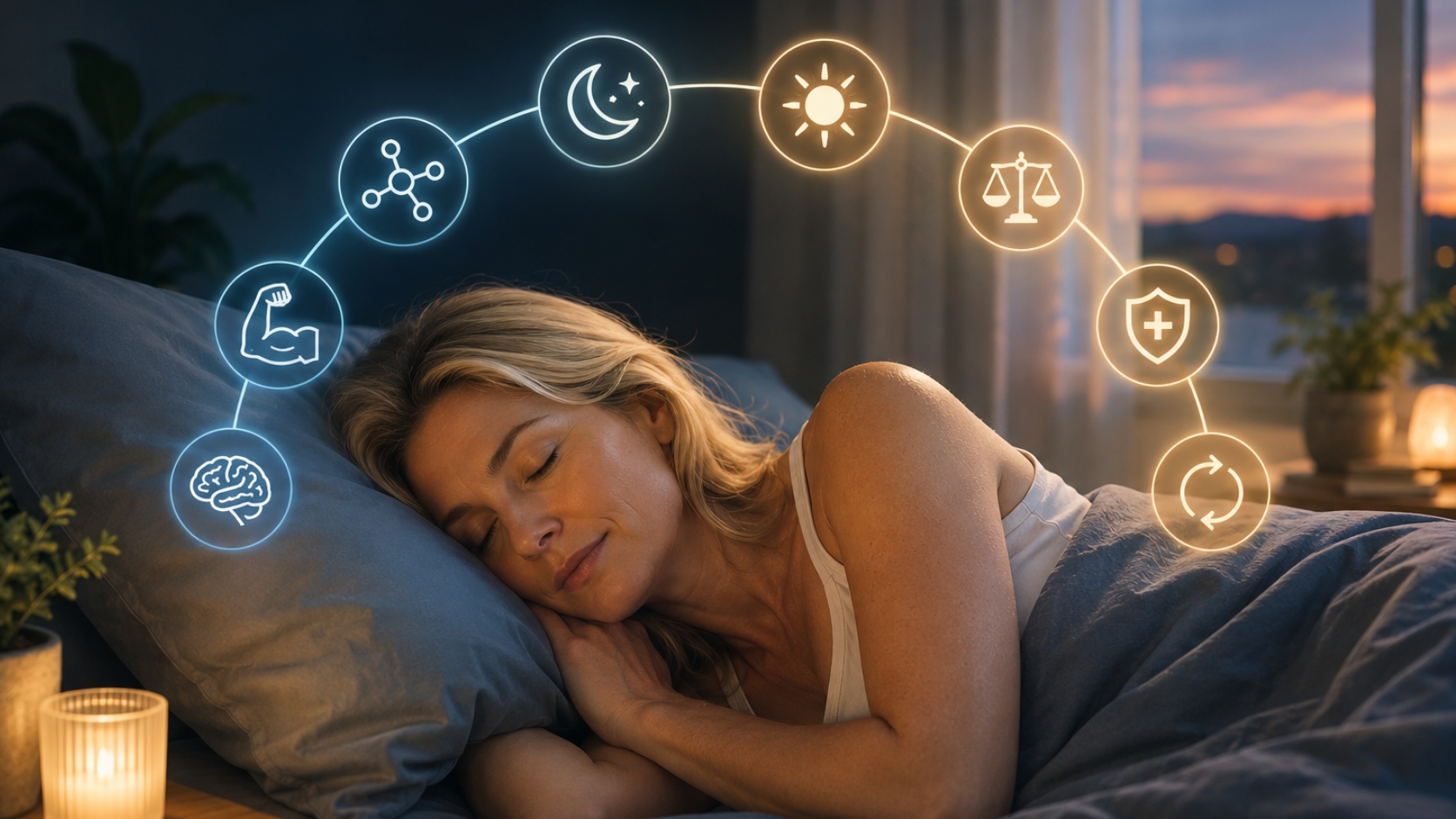
Sleep gets treated like a luxury, the first thing we trade away when life gets busy. That framing is backward. Sleep is one of the engines that makes everything else in your physiology work, and few systems depend on it more directly than your hormones.
If you have ever slept what should have been enough hours and still woken up flat, foggy, and unmotivated, your hormones are part of the explanation. And if you have noticed that your energy, mood, and cravings tend to drift in summer, that is not a coincidence either.
Understanding how sleep affects your hormones is one of the highest-leverage things you can do for how you feel, because unlike many factors in health, sleep is something you can begin to change tonight.
How does sleep affect your hormones?
Sleep is when much of your hormonal housekeeping happens. During the night your body produces and regulates testosterone, releases growth hormone, resets cortisol, and recalibrates the signals that control hunger and blood sugar. When sleep is short or fragmented, every one of those processes is affected, which is why poor sleep shows up not just as tiredness but as changes in body composition, mood, libido, and recovery.
The relationship runs in both directions. Poor sleep disrupts hormones, and disrupted hormones make sleep worse, which is how people get stuck in a cycle that feels like simple aging but often is not.
Consider what that means over an ordinary week. A few late nights, a couple of restless ones, and an early alarm are enough to measurably shift the hormones that govern your energy, your appetite, and your recovery. The effects are not abstract or far off. They show up in how you feel within days, and they compound when short sleep becomes the norm rather than the exception.
Does poor sleep lower testosterone?
Yes, and the effect is larger than most people expect. In a controlled study published in JAMA, healthy young men who slept only five hours a night for one week saw their daytime testosterone drop by 10 to 15 percent. The researchers noted that this decline is comparable to aging ten to fifteen years. One week of short sleep aged these men’s testosterone by more than a decade.
The reason is timing. The majority of a man’s daily testosterone release happens during sleep, concentrated in the deeper stages early in the night. When you cut sleep short or break it up, you cut directly into the window when that hormone is produced. Sleep fragmentation interferes with this even when total time in bed looks adequate, which is part of why conditions like sleep apnea are so strongly linked to low testosterone.
This applies to women as well. Sex hormones, sleep architecture, and mood are tightly linked across the lifespan, and the disrupted sleep of perimenopause and menopause both reflects and worsens shifting hormone levels.
What happens to cortisol when you don’t sleep?
Cortisol is your primary stress and wakefulness hormone, and it is supposed to follow a daily curve: high in the morning to get you going, tapering down through the evening so you can wind down and sleep. Sleep loss flattens and shifts that curve. Research on sleep restriction shows higher afternoon and evening cortisol, exactly when it should be falling.
That matters because cortisol and testosterone pull in opposite directions. Testosterone is the body’s main anabolic, build-and-repair signal. Cortisol is a key catabolic, break-down signal. When sleep loss pushes cortisol up and testosterone down at the same time, it tips the balance toward breakdown. Studies show this imbalance helps drive insulin resistance, which is the early machinery of stubborn weight gain, cravings, and metabolic disease.
Sleep, growth hormone, and recovery
Growth hormone is the body’s repair signal, central to muscle recovery, tissue maintenance, and body composition. The largest pulse of growth hormone is released during deep, slow-wave sleep, usually in the first part of the night. Lose that deep sleep and you lose much of the release.
This connects to something important about aging. Research has shown that the natural decline in deep sleep across adulthood tracks closely with the decline in growth hormone. Some of what we attribute to getting older, the slower recovery and the softer body composition, is partly a story about deteriorating sleep quality, not just the calendar.
Why is sleep harder in summer?
Summer is quietly hostile to good sleep. Longer daylight pushes your circadian rhythm later, so you feel alert when you should be winding down. Heat interferes with the natural drop in core body temperature that your brain uses as a cue to enter deep sleep, which fragments the most restorative stages. And the looser summer schedule, the travel, the late evenings, the irregular timing, scatters the consistency your internal clock depends on.
Put those together and it is no surprise that energy, mood, and appetite can feel off by midsummer. The season is working against the exact mechanisms that keep your hormones steady.
What about sleep and hormones in women?
Women feel this connection acutely, especially in perimenopause and menopause. Falling estrogen and progesterone disrupt sleep directly, and the resulting poor sleep then worsens mood, energy, and metabolic health, creating the same downward loop men experience. Night sweats and early waking are not just nuisances. They are signals of a hormonal shift that is worth evaluating rather than simply enduring. The same logic applies: when better habits do not restore restful sleep, the cause may be hormonal, and it is treatable.
A quick map of sleep and your hormones
| Hormone | What healthy sleep does | What poor sleep does |
|---|---|---|
| Testosterone | Produced mainly during deep sleep | Drops measurably, comparable to aging |
| Cortisol | Falls in the evening for rest | Stays elevated, drives insulin resistance |
| Growth hormone | Peaks in slow-wave sleep for repair | Release is blunted, recovery slows |
| Insulin and appetite | Stay balanced and regulated | Hunger and cravings climb |
What else disrupts sleep more than you think?
Summer is not the only culprit. A handful of everyday habits quietly erode the deep sleep your hormones depend on, and most of them are easy to underestimate.
- Evening alcohol. It may help you fall asleep, but it fragments the second half of the night and suppresses the deep and REM stages where hormonal repair happens.
- Late, heavy meals. Eating close to bedtime keeps your metabolism and core temperature elevated when both should be falling.
- Hard training late at night. Intense exercise raises cortisol and core temperature, which can delay sleep onset for some people.
- Afternoon caffeine. Its effects linger longer than most people assume, and that lingering grows as metabolism slows with age.
None of these has to be eliminated entirely. But if your sleep is suffering, they are the first places to look before assuming the problem is out of your hands.
Why this matters more as you age
The deep, slow-wave sleep that does most of the hormonal heavy lifting declines naturally with age, and it tends to decline early. This is part of why recovery slows and body composition shifts in midlife, often before anyone notices a change in the mirror. The encouraging flip side is that protecting sleep quality becomes one of the most effective things you can do to slow that drift, because you are defending the exact window when testosterone and growth hormone are produced.
What should you fix first?
The encouraging part of all this is that sleep is one of the most responsive levers you have. You do not need a perfect routine. You need a few consistent inputs that your circadian system can lock onto. Start here:
- Anchor your morning with light. Get natural light in your eyes within an hour of waking. Morning light is the strongest signal for setting your internal clock and timing healthy cortisol and melatonin.
- Cool the room. A cooler sleeping environment supports the core temperature drop that triggers deep sleep. Many people sleep best in the mid to upper 60s Fahrenheit.
- Hold one bedtime. Consistency matters more than the exact hour. A steady sleep and wake time, even on weekends, stabilizes the whole hormonal cascade.
- Protect the wind-down. Dim lights in the evening and reduce bright screens, which suppress melatonin and push your rhythm later.
Give these a couple of weeks of real consistency before judging them. For many people, the difference in energy and mood is noticeable quickly.
When a sleep problem is a hormone problem
Here is the honest caveat. Sleep hygiene is powerful, but it is not a cure for everything. If you are doing the basics well and still waking unrefreshed, still dragging through the afternoon, still watching your recovery and your body composition slip, the issue may run deeper than habits. Low testosterone, thyroid dysfunction, elevated cortisol, and sleep-disordered breathing all show up as poor sleep, and none of them resolve by going to bed earlier.
The tell is usually consistency. If you sleep well on some nights and still wake exhausted, or if your sleep changed around the same time your energy, mood, and recovery all slipped, that points toward a systemic cause rather than a behavioral one. Hormones do not respect a good bedtime routine, and no amount of sleep hygiene corrects a thyroid or testosterone problem that is driving the disruption underneath.
At iRevive, we look at sleep and hormones together rather than in isolation, because they are part of the same system. Through our concierge telehealth model, we use comprehensive lab work to understand what is actually happening underneath the fatigue, and we build a plan around your biology and your life. If better habits have not fixed how you feel, that is worth a closer look, not another night of telling yourself to just try harder.
Frequently Asked Questions
Does sleep really affect testosterone?
Yes. In a JAMA study, healthy young men who slept five hours a night for one week had a 10 to 15 percent drop in daytime testosterone, an effect comparable to aging ten to fifteen years. Most daily testosterone is produced during sleep, so short or fragmented sleep directly reduces it.
How many hours of sleep do hormones need?
Most adults need seven to nine hours, but quality and consistency matter as much as quantity. The deep, slow-wave sleep that drives growth hormone and testosterone release happens in defined stages, so fragmented sleep can impair hormones even when total time in bed looks adequate.
Can fixing my sleep balance my hormones on its own?
For some people, improving sleep meaningfully improves energy, mood, and hormonal balance. But sleep is one input among several. If thyroid dysfunction, low testosterone, elevated cortisol, or sleep apnea is present, better sleep habits help but may not fully resolve the problem without further evaluation.
Why do I sleep worse in summer?
Longer daylight shifts your circadian rhythm later, heat interferes with the core temperature drop that triggers deep sleep, and looser summer schedules disrupt consistency. Together these fragment restorative sleep, which is why energy, mood, and cravings often drift in summer.
When should I get my hormones tested for sleep issues?
If you practice good sleep habits and still wake unrefreshed, feel persistently fatigued, or notice changes in mood, libido, recovery, or body composition, comprehensive lab work can identify whether a hormonal or metabolic issue is contributing. iRevive offers this evaluation by telehealth across Florida.
Medical Disclaimer: This article is for educational purposes only and is not medical advice. It is not a substitute for diagnosis or treatment from a qualified clinician. iRevive Integrative & Functional Medicine provides care via telehealth across Florida. Talk with a licensed provider about your individual health needs before making any changes.
<script type="application/ld+json">
{
  "@context": "https://schema.org",
  "@type": "FAQPage",
  "mainEntity": [
    {
      "@type": "Question",
      "name": "Does sleep really affect testosterone?",
      "acceptedAnswer": {
        "@type": "Answer",
        "text": "Yes. In a JAMA study, healthy young men who slept five hours a night for one week had a 10 to 15 percent drop in daytime testosterone, an effect comparable to aging ten to fifteen years. Most daily testosterone is produced during sleep, so short or fragmented sleep directly reduces it."
      }
    },
    {
      "@type": "Question",
      "name": "How many hours of sleep do hormones need?",
      "acceptedAnswer": {
        "@type": "Answer",
        "text": "Most adults need seven to nine hours, but quality and consistency matter as much as quantity. The deep, slow-wave sleep that drives growth hormone and testosterone release happens in defined stages, so fragmented sleep can impair hormones even when total time in bed looks adequate."
      }
    },
    {
      "@type": "Question",
      "name": "Can fixing my sleep balance my hormones on its own?",
      "acceptedAnswer": {
        "@type": "Answer",
        "text": "For some people, improving sleep meaningfully improves energy, mood, and hormonal balance. But sleep is one input among several. If thyroid dysfunction, low testosterone, elevated cortisol, or sleep apnea is present, better sleep habits help but may not fully resolve the problem without further evaluation."
      }
    },
    {
      "@type": "Question",
      "name": "Why do I sleep worse in summer?",
      "acceptedAnswer": {
        "@type": "Answer",
        "text": "Longer daylight shifts your circadian rhythm later, heat interferes with the core temperature drop that triggers deep sleep, and looser summer schedules disrupt consistency. Together these fragment restorative sleep, which is why energy, mood, and cravings often drift in summer."
      }
    },
    {
      "@type": "Question",
      "name": "When should I get my hormones tested for sleep issues?",
      "acceptedAnswer": {
        "@type": "Answer",
        "text": "If you practice good sleep habits and still wake unrefreshed, feel persistently fatigued, or notice changes in mood, libido, recovery, or body composition, comprehensive lab work can identify whether a hormonal or metabolic issue is contributing. iRevive offers this evaluation by telehealth across Florida."
      }
    }
  ]
}
</script>