
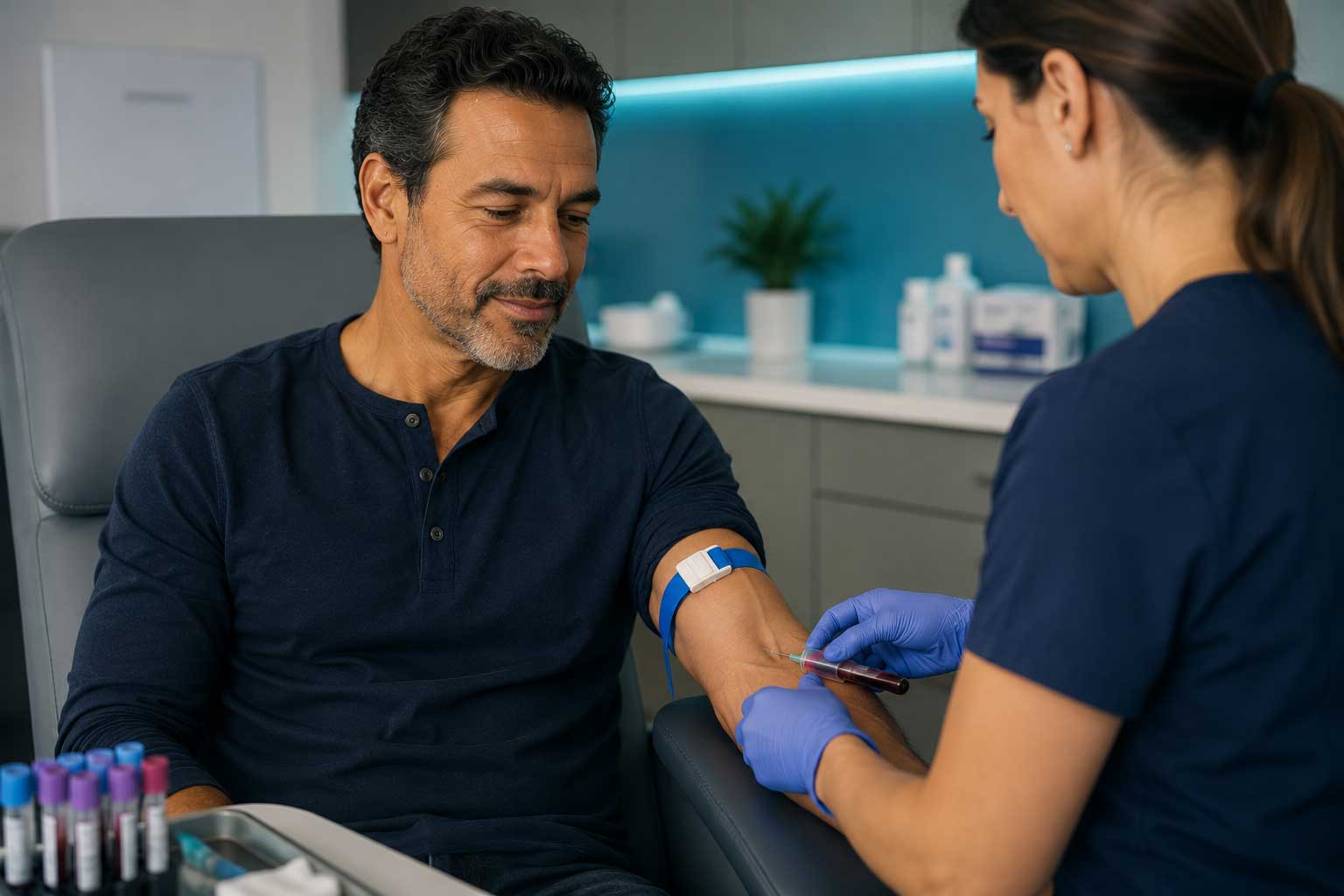
Ask most men when they last had real bloodwork, and the answer is a shrug. A basic physical, maybe a cholesterol check, and a quick reassurance that everything looks fine. For a lot of men, that is the entire picture of their health for years at a stretch.
The problem is what that picture leaves out. The markers that actually predict how a man will feel and function over the next decade, his energy, his strength, his metabolic health, rarely get measured in a standard visit. By the time a routine test flags a problem, the underlying pattern has usually been building quietly for years.
June is Men’s Health Month, which makes it a fitting time to talk about what a genuinely useful men’s checkup looks like. Here are the biomarkers worth tracking once you pass 35, and why testing them early changes what you can do about them.
What blood tests should men over 35 get?
A meaningful men’s panel goes well beyond cholesterol. It should cover hormones, metabolic health, inflammation, and a handful of nutrient and organ markers that quietly shape how you feel. Together these reveal trends years before they become diagnoses.
At a high level, a comprehensive men’s checkup includes:
- Total and free testosterone, plus estradiol
- A full thyroid panel, not TSH alone
- Fasting insulin, fasting glucose, and HbA1c
- A complete lipid panel, ideally including ApoB
- An inflammatory marker such as high-sensitivity CRP
- Vitamin D, ferritin, and a complete metabolic and blood-count panel
Hormones: testosterone and estradiol
Testosterone is the marker men think of first, and for good reason, but it is usually measured poorly or not at all. Levels decline gradually with age, by roughly 1 percent per year after age 30 according to the Endocrine Society. In the large European Male Aging Study, total testosterone fell about 0.4 percent per year and free testosterone about 1.3 percent per year in men aged 40 to 79.
Gradual decline is normal. A steeper drop is not, and it is common. Testosterone deficiency affects roughly 30 percent of men aged 40 to 79, and it is strongly tied to obesity, type 2 diabetes, and metabolic syndrome. Yet it remains under-diagnosed, partly because it is tested incorrectly.
Two details matter. First, free testosterone, the fraction actually available to your tissues, often tells a more accurate story than total testosterone alone. Second, because levels are highest in the morning and vary day to day, testosterone should be drawn in the morning and confirmed with more than one measurement before any conclusion is reached. Estradiol belongs in the panel too, because the balance between testosterone and estrogen, not just the testosterone number, influences how a man feels.
Metabolic markers: fasting insulin, glucose, and HbA1c
If there is one underused test in men’s health, it is fasting insulin. Standard checkups measure fasting glucose, but glucose is a late signal. Insulin rises first, sometimes for years, as the body works harder and harder to keep blood sugar normal. By the time glucose climbs, the metabolic problem is already well underway.
Measuring fasting insulin alongside glucose and HbA1c, which reflects your average blood sugar over about three months, catches that drift early, while it is most reversible. This matters for men in particular because the relationship between metabolic health and testosterone runs in both directions. Low testosterone promotes the accumulation of visceral fat, that deep abdominal fat produces inflammatory signals and aromatase that further lower testosterone, and the resulting insulin resistance deepens the cycle. Research suggests low testosterone can even precede the metabolic changes that lead to diabetes. Catch one early and you have a chance to interrupt the whole loop. This is also why a man can feel his energy and drive fading years before a standard glucose test ever raises a flag, because the earliest signals are hormonal and metabolic, not glycemic.
Inflammation and cardiovascular markers
Cardiovascular disease remains the leading cause of death in men, and a standard cholesterol panel is a blunt tool for assessing risk. Two additions sharpen the picture considerably. High-sensitivity CRP measures low-grade inflammation, a quiet driver of arterial and metabolic disease. ApoB, when available, counts the actual number of artery-damaging particles, which can reveal risk that a normal-looking cholesterol panel hides.
These are not exotic tests. They are simply the ones that get skipped when a checkup is built around the minimum rather than around understanding your actual trajectory. A man can have a reassuring total cholesterol number and still carry meaningful cardiovascular risk that only shows up when inflammation and particle count are measured directly.
The quiet performance levers
A few markers rarely make it onto a basic panel despite having an outsized effect on how a man feels day to day. Vitamin D influences mood, immune function, and testosterone, and deficiency is widespread. Ferritin reflects iron stores and can quietly drain energy when it drifts too low or signal inflammation when too high. A full thyroid panel matters here as well, because thyroid dysfunction mimics low testosterone, with the same fatigue, weight gain, and low mood, and the two are easy to confuse without testing both.
A men’s biomarker reference
| Biomarker | What it reveals | Why it matters early |
|---|---|---|
| Free and total testosterone | Hormonal status and trajectory | Declines with age; deficiency is common and treatable |
| Fasting insulin | Early insulin resistance | Rises years before glucose, when most reversible |
| HbA1c | Average blood sugar over 3 months | Catches metabolic drift before diabetes |
| High-sensitivity CRP | Low-grade inflammation | Quiet driver of heart and metabolic disease |
| Full thyroid panel | Thyroid function and conversion | Mimics low testosterone; easily missed |
| Vitamin D and ferritin | Nutrient and iron status | Common, fixable causes of low energy |
How often should men test?
For most healthy men, a comprehensive baseline followed by annual testing is a sensible rhythm. If something is being actively managed, such as low testosterone, a thyroid issue, or early insulin resistance, more frequent checks make sense until things stabilize. The purpose of regular testing is to see the direction you are trending, not just where you sit on a single day. A trend gives you time to act. A one-time snapshot rarely does, and a single out-of-range value is far less meaningful than a pattern confirmed over time.
What to do once you have your numbers
Numbers are only useful if they change what you do. The encouraging reality is that the markers that matter most respond well to focused effort.
- Build and keep muscle. Resistance training supports testosterone, improves insulin sensitivity, and protects against the body composition shift that drives the whole metabolic cascade.
- Protect your sleep. Most testosterone is produced during sleep, and short sleep measurably lowers it, so this is not optional.
- Address visceral fat. The deep abdominal fat is hormonally active and works against you; losing it improves nearly every marker on the panel.
- Correct what lifestyle cannot. Where diet and training are not enough, targeted medical support can bring hormones and nutrients back into a healthy range.
Most men do not need all of these at once. The right starting point is whatever your own numbers point to, which is the entire reason to measure them in the first place.
Why test early instead of waiting for symptoms?
The case for early testing is simple. Most of what shortens men’s healthspan does not announce itself. Insulin resistance, declining testosterone, rising inflammation, and creeping cardiovascular risk all build silently, and the standard system is designed to catch them once they have become problems, not while they are still trends.
A baseline in your late thirties or early forties turns guesswork into a plan. It lets you see the direction you are heading and act while small adjustments still work, rather than waiting for a diagnosis to force bigger ones. For the men in your life who shrug off checkups, this is the reframe worth sharing, especially around Father’s Day. The goal is not to find disease. It is to protect another healthy decade.
There is a quieter benefit too. Men who see their own numbers tend to engage with their health differently. An abstract warning to eat better rarely changes behavior. Watching your fasting insulin or your testosterone move in the right direction, measurement after measurement, turns vague intentions into something concrete you can influence. Data motivates in a way that advice does not.
How we approach men’s health at iRevive
We want to be clear about one nuance. A single number is not a diagnosis. A low morning testosterone on one draw, or a borderline marker in isolation, means very little without context, repeat testing, and a look at how you actually feel. The value is in the full picture read over time, not in reacting to one result.
This is also why context beats cutoffs. A testosterone level at the low end of normal might be perfectly fine for one man and clearly inadequate for another who has symptoms, a stalled training response, and a family history. The same number can mean different things in different bodies. Reading it well requires knowing the person, not just the printout.
At iRevive, we run a comprehensive men’s panel up front, interpret it against your symptoms and goals, and adjust as the data evolves. Our concierge telehealth model means you work with the same provider, your results are explained in plain language, and Ryan is genuinely reachable when you have questions. This is not a rushed visit and a one-word verdict. It is a real, ongoing look at the biology that determines how you feel and function for the next decade. If it has been years since anyone looked closely, this is a good month to start.
Frequently Asked Questions
What blood tests should men over 35 get?
Beyond a basic cholesterol panel, men over 35 should track total and free testosterone, estradiol, a full thyroid panel, fasting insulin, glucose, HbA1c, a complete lipid panel ideally with ApoB, high-sensitivity CRP, vitamin D, and ferritin. Together these reveal hormonal and metabolic trends years before they become diagnoses.
At what age should men start testing testosterone?
Testosterone declines about 1 percent per year after age 30, so establishing a baseline in your late thirties or early forties is reasonable, and earlier if you have symptoms. Because levels are highest in the morning and vary day to day, testosterone should be drawn in the morning and confirmed with more than one measurement.
What is a normal testosterone level for men?
Reference ranges for total testosterone in adult men generally fall between about 300 and 1,000 ng/dL, depending on age and lab. A number in range is not the whole story, since free testosterone and how you actually feel matter, which is why testing should be interpreted in context rather than against a single cutoff.
Why is fasting insulin important if my glucose is normal?
Insulin rises before glucose does, often for years, as the body works to keep blood sugar normal. Measuring fasting insulin alongside glucose and HbA1c catches early insulin resistance while it is most reversible, well before a standard glucose test would flag a problem.
Can I get a men’s health panel by telehealth?
Yes. iRevive offers comprehensive men’s biomarker testing and ongoing care through a concierge telehealth model across Florida. Lab work is ordered up front, interpreted against your symptoms and goals, and revisited over time with the same provider.
Medical Disclaimer: This article is for educational purposes only and is not medical advice. It is not a substitute for diagnosis or treatment from a qualified clinician. iRevive Integrative & Functional Medicine provides care via telehealth across Florida. Talk with a licensed provider about your individual health needs before making any changes.