
Optimization Is a System, Not a Shortcut: Why One Peptide or One Shot Will Never Fix the Whole You
I talk to people every week who arrive with a very specific request. They want the peptide their friend raved about. They want the weight-loss shot they saw online. They have already decided what the answer is, and they want me to hand it over. I understand the instinct completely. We are wired to want a single lever that fixes the thing that bothers us most. The problem is that the body does not have a single lever. It has dozens, and they are all connected to each other.
That is the heart of what I want to explain here. Real, durable results in functional medicine optimization do not come from buying one product and hoping it does the heavy lifting. They come from understanding your individual biology first, then coordinating several pieces at once and watching how your body responds over time. The shortcut almost always underdelivers. Sometimes it backfires. The system, on the other hand, is what actually changes how you feel and function for years, not weeks.
Why do one-off peptides and shots disappoint?
A single intervention disappoints because it lands in a body that has other things going on. You can add the most promising peptide protocol in the world, but if your sleep is broken, your stress hormones are running high, and your labs were never checked, the peptide is fighting uphill the entire time. The piece is not the problem. The isolation is the problem.
Think about an orchestra. You can hire the finest cellist alive and seat them in the middle of the group. If the violins are sharp, the brass is late, and nobody is following the conductor, that one extraordinary musician does not rescue the performance. The sound is still a mess. What fixes it is not a better cellist. It is tuning, timing, and a score that everyone is reading together.
Bodies work the same way. I have seen people take a growth hormone-supporting peptide for months and feel almost nothing, not because the peptide was wrong, but because their thyroid was sluggish and their cortisol pattern was upside down. Once we addressed those, the same person finally noticed the recovery and sleep benefits they had been chasing. The instrument was fine. It was never playing with the rest of the band.
How are hormones, peptides, and metabolism connected?
They are connected through a constant feedback conversation that never stops running. Your hypothalamus and pituitary sit at the top, reading signals from your stress system, your sleep cycle, your thyroid, and your sex hormones, then adjusting their output to keep everything in balance. Change one input and the others shift to compensate.
Researchers describe the hypothalamus as the coordinating center of the entire endocrine system. It pulls in signals from your nervous system, from light and temperature, and from the hormones already circulating in your blood, then tells the pituitary what to do next. The pituitary, in turn, influences nearly every other gland you have. This is why a single number on a lab report rarely tells the whole story.
Here is a practical example that cuts across men and women alike. Poor sleep raises cortisol. Elevated cortisol suppresses the signals that drive testosterone and disrupts thyroid function. Lower testosterone and a slower thyroid drag down metabolism and energy. Low energy makes exercise and good food choices harder, which feeds back into worse sleep and higher stress. That is a loop, not a list. Peptides and hormones together can support that loop powerfully, but only when we know which part is broken and treat the loop, not a single point on it.
And this is exactly why I get cautious when someone wants to optimize one hormone in a vacuum. Push estrogen or testosterone without looking at thyroid, blood sugar, inflammation, and stress, and you are often just relocating the imbalance, not resolving it.
What does it mean to treat the body as a system?
Treating the body as a system means you stop asking what single thing is wrong and start asking how the parts are influencing each other. You look at the connections between sleep, hormones, metabolism, nutrition, and stress, and you intervene at the points that will move the most dominoes. You measure, you adjust, and you keep watching.
Picture a car with a misaligned engine. You can bolt on a brand-new high-performance part, and for a moment the spec sheet looks better. But if the timing is off and the alignment is wrong, that one shiny component does not make the car run right. It might even put more strain on everything around it. A good mechanic does not just sell you the part you asked for. They put the car on the lift, find out why it is running rough, and fix the relationships between the parts.
That is the difference between a transaction and a system. A transaction sells you the part. A system asks why you needed it and what else has to be true for it to work.
Why does testing come before treatment?
Testing comes first because guessing is expensive, slow, and occasionally harmful. Comprehensive lab testing tells us where your biology actually stands today, not where the internet assumes it stands. Without that map, any protocol is a guess dressed up as a plan.
Two people can walk in with identical complaints, low energy, stubborn weight, poor sleep, and have completely different reasons underneath. One has a thyroid that is barely keeping up and an iron level on the floor. The other has normal thyroid function but high inflammation, blood sugar drifting in the wrong direction, and a stress hormone pattern that explains the 3 a.m. wake-ups. If I handed both of them the same popular peptide, I would help neither of them well. The biomarker analysis is what turns a generic guess into a personalized protocol.
This is also where safety lives. Optimization should never mean pushing a number simply because higher sounds better. It means understanding your baseline, identifying the root cause of what you feel, and choosing interventions that fit your physiology. You cannot personalize what you have not measured.
What does a coordinated, monitored protocol look like?
A coordinated protocol addresses several connected pieces in a deliberate sequence, then tracks your response and adjusts. It is not a product you receive once. It is a relationship that evolves as your labs and your life change.
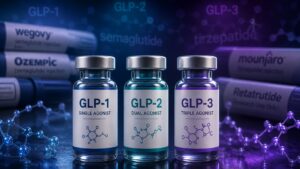
Take medical weight management, which is one of the most requested services I see. GLP-1 weight-management medications are FDA-approved and genuinely effective, and I use them. But rapid weight loss does not only burn fat. Body composition studies of these medications have found that a meaningful share of the weight lost can come from lean tissue, with some trials reporting that lean mass accounts for roughly a quarter to nearly half of total weight lost. That is not a reason to avoid these medications. It is a reason to support them. Protein targets, resistance training, and the right hormonal foundation protect the muscle you do not want to lose. Used alone, the shot can leave someone smaller but weaker. Used inside a system, it helps someone get leaner and stronger at the same time.
The same principle applies to peptide protocols. A peptide layered onto poor sleep, untreated thyroid dysfunction, and runaway stress is a peptide working against the current. The same compound, supported by corrected sleep, balanced hormones, and good nutrition, can do what it was meant to do. The peptide did not change. The system around it did.
Monitoring is the part people skip and the part that matters most. We retest. We watch how your numbers and your symptoms move. We adjust the plan when your body tells us to. That ongoing loop of measure, adjust, and measure again is what separates lasting optimization from a one-time purchase that fades.
| Approach | What it looks like | Typical result |
| The one-off shortcut | Buy a single peptide or shot online or from a friend. No labs, no plan, no follow-up. Treat one symptom in isolation. | Modest or short-lived effect. Frequent disappointment. Occasional setbacks, like losing muscle along with fat or worsening an imbalance you never knew you had. |
| The system approach | Comprehensive biomarker analysis first. A personalized protocol that coordinates hormones, peptides, metabolism, sleep, nutrition, and stress. Ongoing monitoring and adjustment. | Results that compound and hold. Better energy, body composition, and resilience. Fewer surprises, because the plan adapts to your biology over time. |
How does iRevive put the system together?
We start with you, not a product. At iRevive, every relationship begins with comprehensive biomarker analysis, because I will not build a personalized protocol on a foundation I have not measured. From there we coordinate the connected pieces rather than chasing one symptom at a time, and we keep monitoring so the plan stays matched to your biology.
Because we operate as a concierge telehealth practice across Florida, that coordination happens with real access. You are not waiting weeks to ask a question or report a change. When peptides are part of your plan, we work with licensed compounding pharmacy partners and USA-sourced compounds, and we are honest about the regulatory picture. GLP-1 weight-management medications are FDA-approved. Many peptides are compounded or investigational, and the rules around them continue to shift, which is one more reason they belong inside supervised, monitored care rather than a casual online purchase.
Membership starts at $129 a month, and what you are really buying is not a single intervention. You are buying the system: the testing, the coordination, the monitoring, and a clinician who treats your body the way it actually works, as one connected whole. That is what concierge functional medicine is for. Not a shortcut. A plan that gets better the longer we run it together.
Frequently Asked Questions
Is a single peptide ever worth trying on its own?
Occasionally a narrow goal calls for a focused tool, but even then it works best with labs and a clinician behind it. The issue is not the peptide itself. It is using it blind, with no baseline testing, no understanding of the rest of your physiology, and no monitoring. A peptide protocol inside a coordinated plan will almost always outperform the same compound used in isolation.
Why do I need lab testing if I already know my symptoms?
Symptoms tell us something is off. They rarely tell us why. Comprehensive lab testing reveals the root cause, and two people with identical complaints often have completely different underlying drivers. Testing is what turns a generic guess into a personalized protocol and keeps your care safe.
Are GLP-1 medications and peptides the same thing?
No. GLP-1 weight-management medications are FDA-approved and reviewed for safety and effectiveness. Many peptides are compounded or investigational, and their regulatory status is actively changing. Both can have a place in a plan, but they carry different oversight, which is why supervision and monitoring matter.
Can I really get this level of care through telehealth?
Yes. iRevive provides concierge care via telehealth across Florida, which means comprehensive testing, a coordinated personalized protocol, and ongoing monitoring with strong access to your clinician between visits. The system does not require a waiting room. It requires measurement, coordination, and follow-through.
Medical Disclaimer: This article is for educational purposes only and is not medical advice. It does not establish a provider-patient relationship and should not replace consultation with a qualified healthcare professional. Individual results vary, and no specific outcome is guaranteed. GLP-1 weight-management medications are FDA-approved; many peptides are compounded or investigational. Any protocol should follow comprehensive biomarker analysis and ongoing monitoring. iRevive Integrative & Functional Medicine provides care via telehealth across the state of Florida.