Somewhere in your late thirties or forties, the math starts to change. You eat the way you always have, you train the way you always have, and yet the belly fat settles in, recovery slows down, and sleep stops feeling restorative. A meaningful part of that shift traces back to growth hormone, which peaks in your twenties and declines steadily with each decade after. That decline is normal aging. It is also, in the right patient, something we can measure, understand, and address.
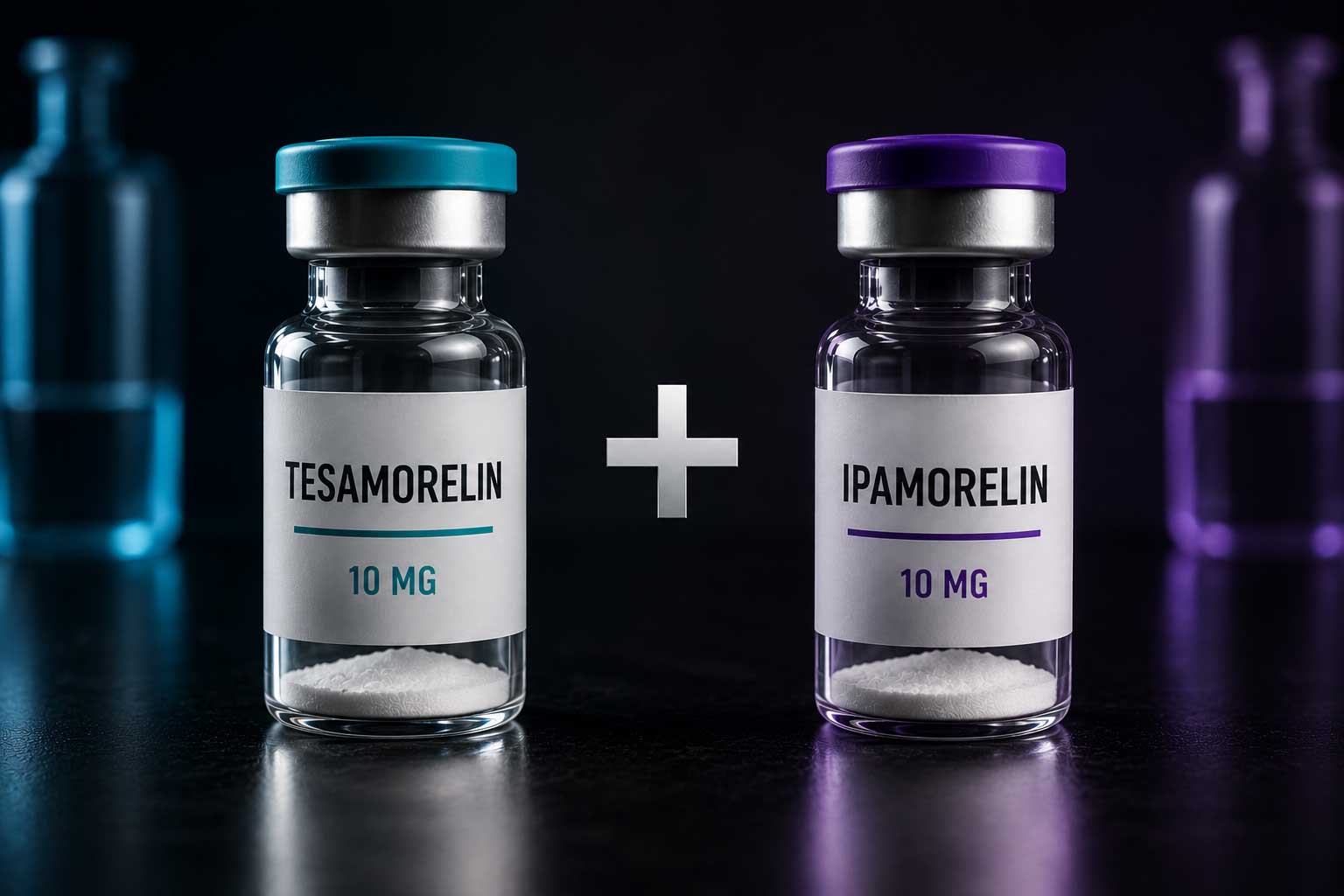
Tesamorelin and ipamorelin are two of the most useful tools I reach for when a patient’s biomarkers and goals point toward growth hormone optimization. They are not shortcuts, and they are not for everyone. But used together, grounded in real lab data and monitored properly, they offer one of the more elegant ways we have to work with the body’s own hormonal machinery rather than override it. Here is how they work, what the research actually shows, and how we use them at iRevive.
What are tesamorelin and ipamorelin?
Tesamorelin and ipamorelin are peptides that prompt your own pituitary gland to release growth hormone. Neither one is growth hormone itself. Instead, each nudges a different upstream switch, which means your body still controls the timing and amount of hormone it produces.
Tesamorelin is a stabilized analog of growth hormone-releasing hormone, or GHRH. It binds the GHRH receptor in the pituitary and stimulates a natural, pulsatile release of growth hormone, which in turn raises circulating IGF-1, the downstream messenger responsible for most of growth hormone’s tissue-level effects. It is FDA-approved for the reduction of excess abdominal fat in adults with HIV-associated lipodystrophy, and it is the only medication carrying that specific indication. When we use it for broader growth hormone optimization outside that population, we are using it off-label and individually, which is a distinction I explain to every patient.
Ipamorelin works through a separate pathway. It is a selective growth hormone secretagogue that binds the ghrelin receptor, the same receptor your stomach’s hunger hormone uses. What makes ipamorelin notable is its cleanliness. Unlike older secretagogues, it triggers growth hormone release with minimal effect on cortisol, prolactin, or appetite. We provide it as a compounded therapy through licensed US compounding pharmacy partners.
How do tesamorelin and ipamorelin work together?
The two peptides act on two different receptors, and that is exactly the point. Tesamorelin drives the GHRH pathway while ipamorelin drives the ghrelin pathway, and when both are engaged, the pituitary produces a more robust, more natural pulse of growth hormone than either does on its own.
Think of it as two hands on the same lever. GHRH tells the pituitary to release growth hormone. The ghrelin pathway amplifies that signal and helps suppress somatostatin, the brake that normally shuts growth hormone release down. Recruiting both pathways together tends to produce a stronger, more physiologic pulse, which is why this pairing has become a common framework in peptide-based growth hormone peptides protocols.
And here is the part I want patients to understand. Because these peptides stimulate your own gland, they preserve the natural feedback loops that keep growth hormone in a healthy range. Your body can still say no. That is a meaningfully different safety profile than injecting synthetic growth hormone directly, which bypasses those controls entirely.
What are the benefits of tesamorelin and ipamorelin?
The benefits patients care about most cluster around body composition, recovery, and how they feel day to day. The strongest evidence sits with tesamorelin’s effect on abdominal fat, with supporting rationale for the broader effects that follow from raising growth hormone and IGF-1.
The most studied benefit is visceral fat reduction, which I will cover in detail below. Beyond that, growth hormone and IGF-1 play a direct role in muscle protein synthesis and the maintenance of lean body mass. Age-related decline in the GH/IGF-1 axis is one of the recognized contributors to sarcopenia, the progressive loss of muscle and strength that accompanies aging. That is a large part of why we position these peptides as tools for preservation, not just fat loss.
Sleep and recovery are the effects patients notice first. Growth hormone secretion in adults is tightly linked to slow-wave sleep, the deepest and most restorative stage. Roughly 70 percent of GH pulses during sleep coincide with slow-wave sleep, and the amount of hormone released tracks with the amount of deep sleep you get. Patients frequently report deeper sleep and better recovery early in a protocol, and the physiology supports why.
There is also credible rationale for skin, collagen, and tissue-repair benefits, since IGF-1 signaling supports fibroblast activity and wound healing. I present those as reasonable expectations rather than guarantees, because the human data there is thinner than the fat and metabolic data.
Does tesamorelin reduce visceral and liver fat?
Yes, and this is where the evidence is genuinely strong. Visceral fat, the deep abdominal fat that wraps around your organs, is the fat most tightly linked to insulin resistance, cardiovascular risk, and inflammation. Tesamorelin has been shown in large randomized trials to reduce it.
In a pooled analysis of 806 participants across two phase III trials, tesamorelin reduced visceral adipose tissue by roughly 15 percent versus placebo over 26 weeks. That is not a marginal effect. It is a clinically meaningful shift in the exact fat depot that drives metabolic disease.
The liver findings are just as interesting. In a randomized, double-blind trial published in JAMA, tesamorelin reduced both visceral fat and liver fat over six months. A later randomized trial in The Lancet HIV followed patients with non-alcoholic fatty liver disease over 12 months and found that tesamorelin produced a 37 percent relative reduction in liver fat fraction, with more than a third of treated patients dropping below the threshold for fatty liver entirely.
Here is the honest nuance I owe every patient. Much of this high-quality data comes from studies in people with HIV-associated fat accumulation, because that is the population tesamorelin was developed and approved for. The mechanism is not HIV-specific, and the metabolic biology translates reasonably to other adults with visceral adiposity. But it is individualized, off-label use, and I am direct about where the evidence is strongest and where we are extrapolating.
How long does it take to see results?
Different benefits arrive on different timelines, and setting that expectation early is part of doing this well. The subjective improvements tend to come first, and the body-composition changes take longer.
Many patients notice improvements in sleep quality, energy, and recovery within the first few weeks. That aligns with the tight relationship between growth hormone pulses and deep sleep. Body-composition changes, particularly reductions in visceral fat and shifts in lean mass, typically take a couple of months to become measurable, which matches the 26-week timelines in the visceral fat trials.
We do not ask you to guess whether it is working. Progress is tracked with follow-up IGF-1 labs and body-composition assessment, so we are looking at objective markers alongside how you feel. If the numbers and the symptoms are not moving in the right direction, that tells us something, and we adjust.
Is it safe, and what are the side effects?
For appropriately selected and monitored patients, these peptides have a favorable and well-characterized safety profile. The most common side effects are mild and manageable, and the entire point of doing this under clinical supervision is to catch and address anything that emerges.
The most frequently reported effects are injection-site irritation, mild fluid retention, and temporary joint stiffness, all of which reflect growth hormone’s known physiology and often ease with adjustment. Because growth hormone influences glucose metabolism, we monitor for changes in insulin sensitivity, which is one reason baseline and follow-up metabolic labs are non-negotiable in our protocols.
Ipamorelin’s selectivity is part of the safety story. In controlled research, it stimulated growth hormone release without the meaningful rises in cortisol and prolactin seen with older secretagogues, which is why it is preferred in modern peptide therapy. These therapies are not appropriate for everyone. Active malignancy, certain pituitary conditions, and pregnancy are among the situations where we would not proceed, and that is exactly what the upfront workup is designed to screen for.
Who is a good candidate?
The best candidates are adults whose goals, symptoms, and biomarkers all point in the same direction. This is not a therapy I recommend based on interest alone. It is a therapy I recommend based on data.
In practice, good candidates are often adults over 40 with signs of declining growth hormone, stubborn visceral fat that persists despite genuinely good diet and exercise, or a need for regenerative support during recovery from surgery, injury, or muscle wasting. Patients with early metabolic concerns, including fatty liver or elevated cardiometabolic risk, are another group where the visceral and hepatic fat data is especially relevant.
What makes someone a good candidate is not a symptom checklist. It is a full picture. That is why we always start with comprehensive biomarker analysis, and why optimization is a system rather than a single prescription.
Comparison: Tesamorelin vs Ipamorelin
| Tesamorelin | Ipamorelin | |
| What it is | Stabilized GHRH analog | Selective GH secretagogue (pentapeptide) |
| Receptor / mechanism | Binds the GHRH receptor in the pituitary | Binds the ghrelin receptor (GHS-R1a) |
| FDA status | FDA-approved for HIV-associated lipodystrophy; other uses off-label | Compounded therapy; not separately FDA-approved for this use |
| Primary role | Drives visceral and liver fat reduction, raises IGF-1 | Amplifies the GH pulse, minimal cortisol or prolactin effect |
| Notes | Strongest human data, largely from HIV-associated fat studies | Prized for its clean, selective hormonal profile |
How does iRevive use tesamorelin and ipamorelin?
At iRevive, tesamorelin and ipamorelin are part of our peptide and optimization programs, prescribed by me when the workup supports it and sourced through licensed US compounding pharmacy partnerships. But the peptides are the easy part. The clinical rigor around them is what makes them work safely.
Every patient starts with comprehensive biomarker analysis, including IGF-1 along with metabolic and hormone markers, so we know exactly where you stand before anything is prescribed. From there we build a personalized protocol matched to your labs and goals, pair it with muscle-preservation and lifestyle support, and track progress with ongoing monitoring and repeat labs. You are not left to figure it out alone. You have direct access to me and the clinical team throughout.
And all of it runs through concierge telehealth across Florida, with membership starting at $129 per month. That means real clinician access, real lab work, and real follow-up, without the friction of a traditional office. If you want to know whether your growth hormone axis is part of what is holding you back, the honest answer starts with your bloodwork. Explore our services to see how we begin.
Frequently Asked Questions
Is tesamorelin the same as growth hormone?
No. Tesamorelin is a GHRH analog that prompts your own pituitary gland to release growth hormone in a natural, pulsatile pattern. It preserves your body’s feedback controls, which is a different and generally safer approach than injecting synthetic growth hormone directly.
Why combine tesamorelin and ipamorelin instead of using one?
Because they work on two different receptors. Tesamorelin activates the GHRH pathway and ipamorelin activates the ghrelin pathway, so using both produces a more robust, more physiologic growth hormone pulse than either does alone. It is a synergy of mechanisms, not just a higher dose.
How is my progress measured on this therapy?
We track objective markers, not just how you feel. Follow-up IGF-1 labs show whether the therapy is raising growth hormone signaling as intended, and body-composition assessment measures the fat and lean-mass changes over time. That data drives every adjustment we make.
Does insurance cover tesamorelin for optimization?
Tesamorelin is FDA-approved specifically for HIV-associated lipodystrophy, so insurance coverage is generally tied to that indication. When we use these peptides for broader optimization, it is off-label and typically self-pay, which we discuss transparently as part of your membership.
Medical Disclaimer: This article is for educational purposes only and does not constitute medical advice, diagnosis, or treatment. Tesamorelin is FDA-approved for HIV-associated lipodystrophy; other uses described here are off-label and individualized. Ipamorelin is provided as a compounded therapy. Individual results vary, and no outcome is guaranteed. Peptide therapy requires clinical evaluation and ongoing monitoring. iRevive Integrative & Functional Medicine provides care via concierge telehealth across Florida. Always consult a qualified healthcare provider before starting any new therapy.