
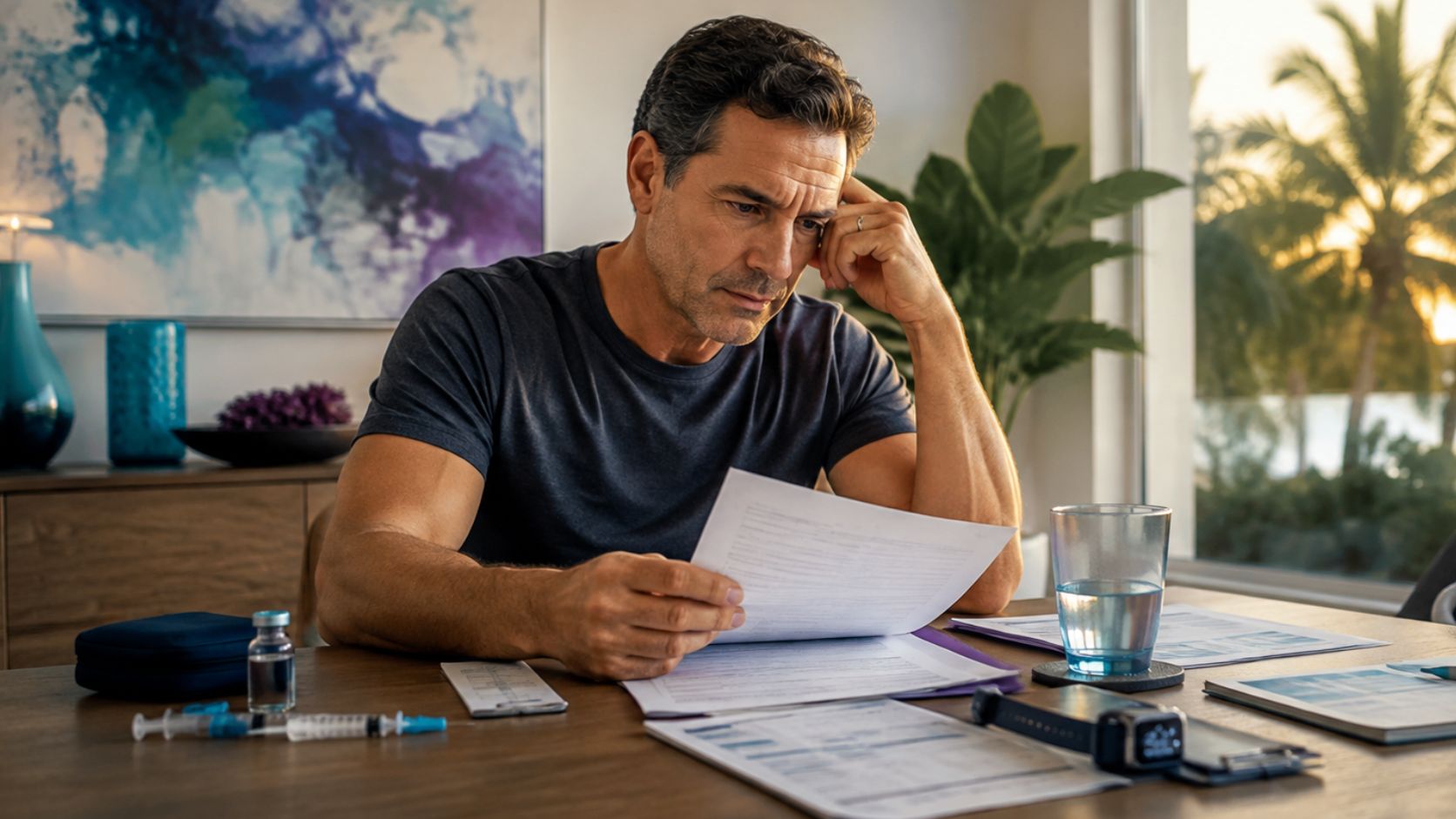
Quick answer: TRT can improve symptoms in men with confirmed hypogonadism, but fatigue is not specific to testosterone deficiency. A man can have a higher total-testosterone level and still feel tired because free testosterone is inadequate, labs were drawn at the wrong time, the formulation creates peaks and troughs, sleep apnea or thyroid disease is untreated, iron or blood counts are abnormal, metabolic or mental-health factors are active, or the treatment itself has created a monitoring problem such as elevated hematocrit.
Your testosterone result improved. Your energy did not.
That is more common than the marketing around TRT would suggest. Testosterone therapy is effective for appropriately selected men with consistent symptoms and unequivocally low testosterone, but fatigue is one of the least specific symptoms in medicine. The Endocrine Society therefore recommends diagnosing hypogonadism only when symptoms are paired with consistently low total and/or free testosterone, followed by evaluation of the underlying cause.[1]
The distinction matters. In the Testosterone Trials, treatment raised testosterone into the mid-normal range and improved sexual outcomes, but it did not produce a significant improvement in the primary vitality measure.[2] That does not mean TRT “does not work.” It means energy is influenced by far more than one hormone.
If you are on TRT and still tired, the next step is not automatically a higher dose. It is a structured review of the diagnosis, the laboratory pattern, the way the medication is being used, and the other conditions that can create the same symptom.
1. The Original Symptom May Not Have Been Caused by Low Testosterone
Low libido, fewer morning erections, reduced spontaneous sexual thoughts, and loss of secondary sexual characteristics are more specific to androgen deficiency than fatigue alone. Energy loss, low mood, poor concentration, weight gain, and slower recovery overlap with sleep disorders, thyroid disease, anemia, diabetes, depression, medication effects, chronic pain, and under-recovery from training.
This is why a list of signs of low testosterone should start an evaluation, not finish one. If testosterone was low and treatment corrected the level but the dominant symptom did not change, the clinical question needs to widen.
2. Total Testosterone Is Higher, but Free Testosterone May Still Be Inadequate
Total testosterone measures testosterone circulating in several forms. Much of it is bound to sex hormone-binding globulin, or SHBG, and is not readily available to tissues. When total testosterone is near a decision threshold or a condition alters SHBG, the Endocrine Society recommends obtaining an accurate free-testosterone measurement or calculation.[1]
A man can therefore have a reassuring total number while free testosterone remains lower than expected. The reverse can also occur. The goal is not to force every marker to the top of its range. It is to understand total testosterone, free testosterone, SHBG, symptoms, and treatment timing together. The broader men’s biomarker guide explains why the pattern matters more than one headline result.
3. The Lab Was Drawn at the Wrong Point in the Dosing Cycle
Testosterone gels, short-acting injections, longer-acting injections, pellets, and other formulations have different pharmacokinetic profiles. The timing of the blood draw relative to the dose changes what the number means. An injection measured near its peak can look excellent even if symptoms return before the next dose. A result drawn at the trough can look low even when the average exposure is adequate.
Guidelines recommend selecting and monitoring therapy with the formulation’s pharmacokinetics in mind.[1] A useful review therefore asks when the dose was taken, when the blood was drawn, whether the schedule is consistent, and whether symptoms follow a predictable peak-and-trough pattern.
4. Sleep Quantity or Sleep Apnea Is Still Driving Daytime Fatigue
Testosterone cannot replace restorative sleep. Obstructive sleep apnea commonly presents with unrefreshing sleep, daytime fatigue or sleepiness, loud snoring, witnessed pauses in breathing, morning headaches, and impaired concentration. The American Academy of Sleep Medicine recommends formal sleep testing when clinical suspicion is present rather than relying on a questionnaire alone.[3]
Untreated severe obstructive sleep apnea is also listed by the Endocrine Society as a reason not to initiate testosterone therapy until it is addressed.[1] For a man who remains exhausted on TRT, especially one who snores, has hypertension, has gained weight, or wakes unrefreshed, a sleep evaluation may be more useful than another dose increase.
5. Thyroid Function Is Contributing to the Same Symptom Pattern
Hypothyroidism can produce fatigue, cold intolerance, weight gain, dry skin, constipation, and cognitive slowing.[4] Those complaints overlap heavily with the way men describe low testosterone. If the thyroid was never evaluated—or if symptoms have changed since the last evaluation—it deserves a place in the differential diagnosis.
A thyroid review should be clinically appropriate rather than an automatic hunt for “optimal” values. The purpose of a complete thyroid panel is to answer a specific question in context, not to label every borderline result as disease.
6. Iron Deficiency, Anemia, or Another Blood-Count Problem Is Being Missed
Iron deficiency can contribute to fatigue even before severe anemia is present, while anemia itself can reduce exercise tolerance and concentration.[5] A complete blood count, ferritin, iron studies, B12, folate, kidney function, and other testing may be appropriate depending on the patient’s history and symptoms.
The other side of the blood-count discussion is equally important: testosterone can stimulate red-blood-cell production. Erythrocytosis is one of the most common treatment-related issues, which is why hematocrit belongs in a standardized monitoring plan[1][6].
7. Metabolic Health, Medications, Mood, or Training Load Is the Real Bottleneck
Insulin resistance, poorly controlled diabetes, substantial calorie restriction, alcohol use, sedating medications, some antidepressants, chronic pain, depression, and excessive training without adequate recovery can all flatten energy. Testosterone may improve one part of the system without correcting those inputs.
This does not mean every tired patient needs an enormous panel. It means the evaluation should follow the history. A man whose fatigue began after a medication change needs a different workup from a man with loud snoring, a man with unexplained weight loss, or a man training six days a week while eating too little.
8. The TRT Protocol Needs Adjustment—or Has Created an Adverse Effect
The Endocrine Society recommends evaluating response, adverse effects, adherence, serum testosterone, hematocrit, and prostate risk during treatment.[1] Persistent fatigue can coexist with under-dosing, inconsistent dosing, supraphysiologic peaks, high hematocrit, worsening sleep-disordered breathing, or another adverse effect.
An elevated hematocrit does not always cause fatigue, and a symptom should not be assigned to it without evaluation. But it is a safety issue that requires action. Clinical guidance recommends reducing or holding therapy when hematocrit exceeds 54% until it normalizes and the cause is addressed.[6]
What a Useful TRT Troubleshooting Review Looks Like
Question
Why It Matters
Was hypogonadism documented before treatment?
Symptoms plus repeated, accurate testosterone measurements help confirm that TRT was treating the right problem.
What formulation and schedule are being used?
Different products produce different peaks, troughs, absorption patterns, and adherence challenges.
When were the labs drawn?
A number without dose timing can be misleading.
What do free testosterone and SHBG show?
They help interpret biologically available testosterone when total testosterone is incomplete.
Are CBC/hematocrit and prostate monitoring current?
TRT requires ongoing safety monitoring, not only symptom tracking.
What other causes fit the history?
Sleep apnea, thyroid disease, iron deficiency, metabolic conditions, medication effects, and mood disorders can mimic low-T fatigue.
When Persistent Fatigue Needs Prompt Medical Attention
Seek prompt medical assessment for fatigue accompanied by chest pain, shortness of breath, fainting, new neurologic symptoms, black or bloody stools, rapid unexplained weight loss, severe depression, or thoughts of self-harm. Those are not “optimization” questions and should not wait for a routine hormone follow-up.
How iRevive Approaches Men Who Are Still Tired on TRT
At iRevive, the question is not simply whether the total-testosterone number is higher. Ryan reviews the original diagnosis, treatment formulation, dose timing, total and free testosterone, SHBG, CBC and hematocrit, thyroid and metabolic markers when indicated, sleep risk, medication history, and the symptom timeline. That approach is part of iRevive’s men’s testosterone therapy and performance optimization service.
The practice is based in the Lakewood Ranch area and serves Sarasota, Bradenton, Venice, and patients throughout Florida by telehealth. Men who are considering a second opinion can also review what to expect at the first HRT consultation before they request a consultation.
Frequently Asked Questions
Why am I still tired even though my testosterone level is normal on TRT?
Because fatigue is not specific to testosterone deficiency. Free testosterone, SHBG, dose timing, sleep apnea, thyroid disease, iron deficiency, metabolic health, medications, mood, and TRT-related changes such as elevated hematocrit can all matter. A clinician should review the full pattern rather than respond to one total-testosterone value.
Does feeling tired on TRT mean I need a higher dose?
No. A higher dose may be appropriate in some cases, but increasing it without reviewing timing, adherence, free testosterone, side effects, sleep, and other causes can miss the real problem and increase risk.
Which labs are commonly reviewed when TRT is not working as expected?
The exact workup depends on the history, but it often includes total and free testosterone, SHBG, CBC and hematocrit, metabolic markers, and prostate monitoring. Thyroid, iron, B12, or other testing may be appropriate when the symptom pattern supports it.
Can sleep apnea make TRT feel ineffective?
Yes. Untreated obstructive sleep apnea can cause unrefreshing sleep, daytime fatigue, impaired concentration, and poor exercise recovery. Severe untreated sleep apnea is also a guideline-listed reason to defer starting testosterone therapy.
Does iRevive review TRT protocols started by another clinic?
Yes. iRevive can review the original diagnosis, current medication and schedule, recent labs, response, side effects, and unresolved symptoms for men in Lakewood Ranch and throughout Florida by telehealth.
Medical Disclaimer
This article is for educational purposes only and does not provide medical advice, diagnosis, or treatment. It does not establish a clinician-patient relationship. Individual eligibility, risks, medication choice, dosing, and monitoring require evaluation by a qualified licensed clinician. Results vary.